
Introduction: The Paradox That Saved My Mornings
For years, I avoided caffeine like a trigger.
After heroin, after prison, after the chaos of raising two children alone—my nervous system couldn’t handle spikes. Coffee made my heart race, my thoughts scatter, my anxiety flare. I needed focus, but not at the cost of calm.
Then I rediscovered green tea.
Not as a “healthy alternative,” but as a biochemical paradox: a beverage that contains caffeine and induces stillness.
That’s when I remembered L-theanine—the amino acid almost exclusive to Camellia sinensis.
And I realized: this wasn’t magic. It was evolutionary pharmacology.
This article explains how these two molecules—one stimulating, one soothing—create something rare: calm focus.
The Problem with Isolated Stimulants
Most people reach for coffee, energy drinks, or nootropics when they need alertness. But isolated stimulants come with hidden costs:
- Caffeine alone blocks adenosine receptors, preventing sleep pressure—but it also triggers a sharp dopamine surge followed by a crash.
- Cortisol spikes within 20 minutes, activating the sympathetic nervous system (“fight or flight”).
- Glutamate excitotoxicity can lead to mental fog, irritability, and long-term HPA axis dysregulation.
I’ve seen this cycle destroy brilliant minds—my own included.
Stimulants without modulation aren’t performance enhancers. They’re depletion accelerators.
How L-Theanine Changes the Game
L-theanine (γ-glutamylethylamide) is a non-protein amino acid found almost exclusively in tea. Structurally, it resembles glutamate—but its effects are counterintuitive.
Mechanisms of action:
- Crosses the blood-brain barrier within 30–50 minutes of ingestion.
- Increases GABA, the brain’s primary inhibitory neurotransmitter—reducing neuronal noise.
- Elevates alpha brain wave activity, the same pattern observed in meditators: relaxed alertness, not drowsiness.
- Modulates dopamine and serotonin in the prefrontal cortex, enhancing mood without euphoria.
But the real genius lies in its interaction with caffeine.
The Synergy: Why Tea ≠ Coffee + L-Theanine Supplement
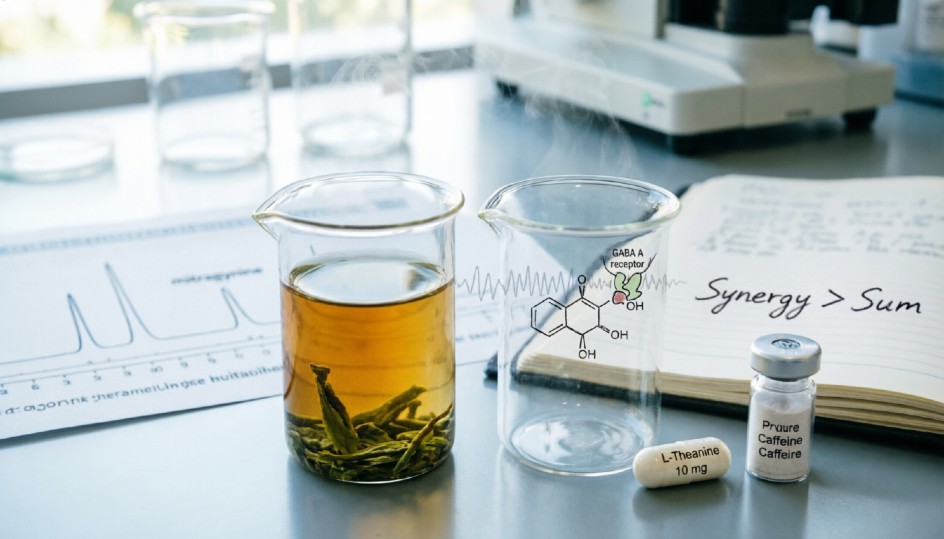
When L-theanine and caffeine coexist—as they do naturally in green, white, and oolong tea—they create a pharmacokinetic partnership that neither achieves alone.
| Effect | Caffeine Alone | Caffeine + L-Theanine |
|---|---|---|
| Attention | Narrow, jittery focus | Broad, sustained attention |
| Anxiety | Often elevated | Significantly reduced |
| Dopamine curve | Sharp peak → crash | Smooth, prolonged release |
| Cognitive flexibility | Reduced under stress | Enhanced (per 2012 RCT in Nutritional Neuroscience) |
This isn’t additive. It’s synergistic.
Evolution didn’t pair these molecules by accident. Plants produce L-theanine partly to protect against insect overstimulation—ironically, the same protection humans now need in a hyper-stimulated world.
Science note: The ideal ratio is ~2:1 (L-theanine to caffeine). A cup of sencha (~25 mg caffeine, ~10 mg L-theanine) comes close. Most supplements use 100–200 mg L-theanine with 50 mg caffeine—a crude approximation of nature’s balance.
Why We Serve Whole-Leaf Tea—Not Extracts
At Lovely, we don’t sell L-theanine pills or “focus shots.”
We serve whole-leaf organic teas: Sencha, Matcha, Silver Needle, Qilan Oolong.
Why? Because:
- Polyphenols (like EGCG) further modulate COMT enzyme, slowing dopamine breakdown.
- Volatile oils and flavonoids enhance bioavailability and reduce gastric irritation.
- The ritual of brewing—heating water to 70–85°C, waiting, inhaling steam—activates parasympathetic tone before the first sip.
Isolation strips context.
Whole-plant synergy preserves it.
A Personal Note: Focus Without Fear
After my wife died, I had to be present—for parent-teacher conferences, for bedtime stories, for grief that came unannounced.
I couldn’t afford the crash of coffee. But I also couldn’t afford mental fog.
Green tea became my anchor.
Not because it “relaxed” me—but because it let me think clearly while feeling safe.
L-theanine didn’t numb my pain. It gave my nervous system the bandwidth to hold it.
Conclusion: Calm Focus Is a Choice—Not a Trait
You don’t have to be born with monk-like concentration.
You don’t have to choose between productivity and peace.
Calm focus is available to anyone willing to work with biology, not against it.
At Lovely, we offer the tools—not promises, but mechanisms.
Brew a cup of sencha. Sit for five minutes. Notice how your breath slows, your thoughts clarify, your shoulders drop.
That’s not wellness.
That’s neurochemistry meeting intention.
And in a world that glorifies burnout, that’s revolutionary.
Filipp
Founder, Lovely
Aurora, Colorado
P.S. Our green teas are sourced from shaded farms in Japan and China, tested for heavy metals and pesticides, and steeped at precise temperatures to preserve L-theanine and EGCG. Served in 16 oz portions ($5). No extracts. No shortcuts. Just tea, as evolution intended.